 Fintech

 Pharma
 Manufacturing
 Advertising
The 47% AI Hiring Delay Problem: How Slow Hiring Cycles Are Impacting Business Outcomes
Artificial Intelligence initiatives are increasingly dependent on one critical factor: access to skilled talent. However, across industries, hiring delays in AI roles have become one of the most significant barriers to execution.According to McKinsey & Company, 47% of executives report that AI initiatives are progressing too slowly, with 46% directly attributing this slowdown to talent gaps and hiring challenges. This indicates that nearly 1 in 2 organizations are unable to execute AI projects on time due to delays in hiring the required expertise.
Let’s connect
Book a meeting
The 3 to 6 Month Hiring Delay in AI Roles
AI hiring cycles are significantly longer than traditional roles due to high specialization and limited talent supply.
Industry data shows:
- AI/ML roles typically take 3–6 months to fill
- Advanced roles (GenAI, MLOps) can take 6–9 months
- AI talent demand is growing 2- 3x faster than supply
Insights referenced by The White House highlight that AI talent shortages are a structural workforce issue, not a short-term gap. Similarly, the World Economic Forum identifies talent scarcity in AI as one of the top barriers to business transformation globally.
Every 90 to 180 day hiring delay directly postpones project execution by the same duration
Time to Execution Impact: Direct Delays in Business Outcomes
When hiring takes months, execution timelines expand proportionally.
Typical impact of AI hiring delays:
- 3 – 6 month hiring cycle → 3 – 9 month delay in project delivery
- AI initiatives remain inactive while roles are unfilled
- Time-to-market for AI-driven products increases significantly
According to McKinsey & Company, organizations with talent constraints experience up to 2x slower execution cycles, meaning projects take twice as long to move from planning to production.
Productivity Loss Due to Unfilled AI Roles
Unfilled AI positions create measurable productivity gaps within teams.
Data indicates:
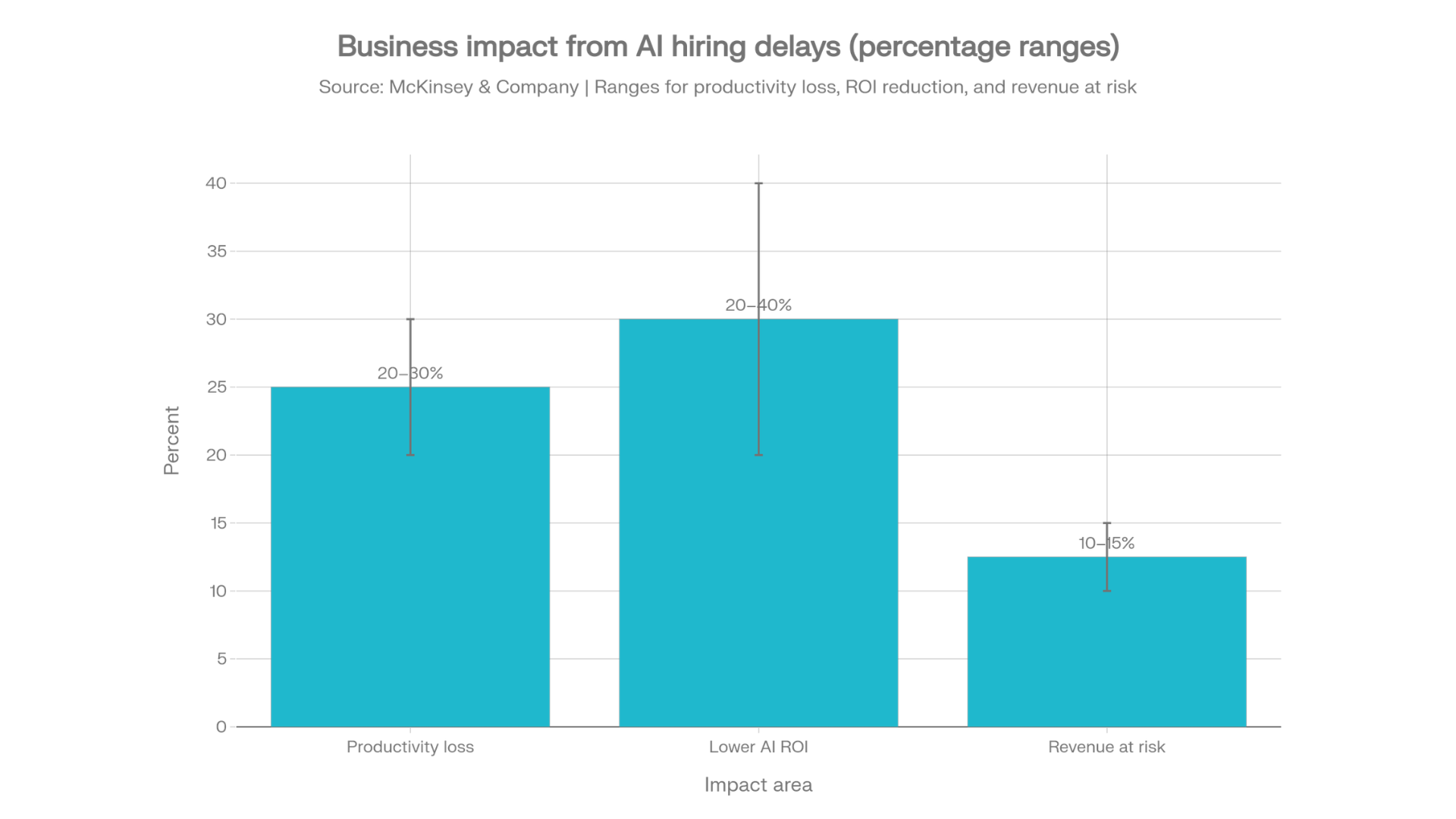
- Talent mismatches and shortages can reduce productivity by 20–30%
- Teams operate below required capability levels during hiring gaps
- Existing resources are stretched, slowing parallel initiatives
Research from McKinsey & Company shows that inadequate workforce planning significantly impacts operational efficiency, especially in high-skill domains like AI.
A single delayed hire affects not just one role, but the productivity of the entire project team
Revenue and ROI Impact of Hiring Delays
Hiring delays in AI roles directly affect financial performance.
Organizations facing prolonged hiring cycles often experience:
- 20–40% lower ROI on AI investments
- Lost opportunities in competitive markets due to slower deployment
According to McKinsey & Company, inefficient talent allocation and delays in capability building can result in significant ROI leakage, limiting the financial impact of AI programs.
Additionally, companies that fail to optimize talent deployment risk losing up to 10–15% of annual revenue potential due to delayed execution.
Compounding Business Impact of Hiring Delays
AI hiring delays create a cascading effect across business functions:
- Projects remain in pilot stages for extended periods
- Dependencies across teams increase execution bottlenecks
- AI infrastructure investments remain underutilized
- Strategic initiatives lose momentum
Organizations with persistent hiring delays experience:
- 2x slower execution speeds
- 20–30% productivity decline
- Delayed ROI realization by multiple quarters
According to McKinsey & Company, workforce inefficiencies significantly slow down execution timelines across organizations.
AI Hiring Delays Are a Structural Constraint
The shortage of AI talent is expected to continue long-term.
According to The White House, AI workforce demand is projected to grow 3–5x by 2030, intensifying competition for skilled professionals. The World Economic Forum also highlights that advanced technology skill gaps will remain one of the biggest global workforce challenges.
This means:
- Hiring timelines will not shorten significantly
- Talent competition will continue to increase
- Delays in hiring will remain a persistent business risk
Conclusion: Hiring Delays Are Directly Impacting AI Outcomes
The data clearly shows that AI hiring delays are not isolated operational issues, they have direct, measurable business consequences.
With:
- 47% of organizations reporting slow AI progress
- 3 – 6 month hiring cycles (extending to 6 – 9 months for advanced roles)
- 20 – 30% productivity loss due to talent gaps
- 20 – 40% reduction in expected ROI
AI hiring delays are a primary driver of delayed execution, reduced efficiency, and lost revenue opportunities.
In an environment where speed determines competitive advantage,
every delayed hire translates into delayed business outcomes.
Global success stories
Here are some related content that highlight our capability in delivering AI solutions that save costs as well as boost productivity.
Manufacturing 4.0: